






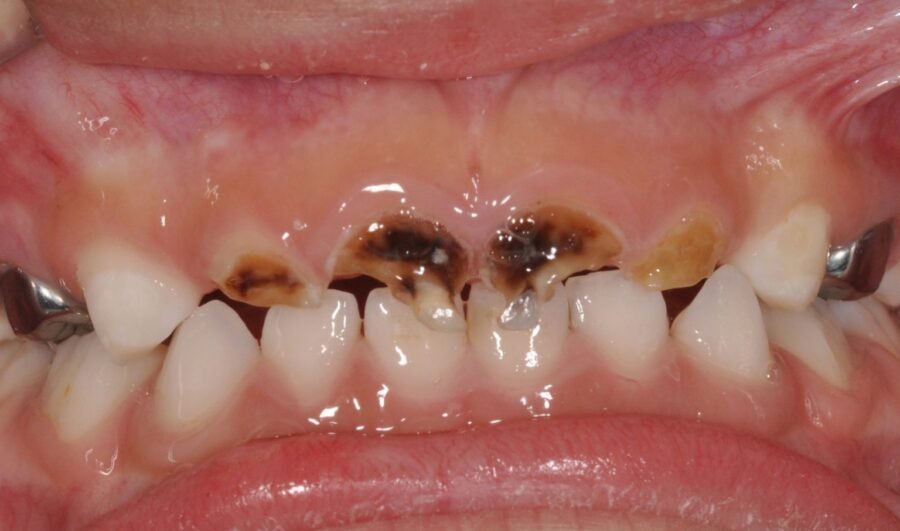
Tooth decay is a common condition among children in Nigeria, yet widely overlooked and misunderstood.
Despite being preventable, many parents remain unaware of the everyday habits that put their children’s dental health at risk.
Experts warn that sugary diets, inadequate brushing techniques, and a lack of fluoride are among the major causes of tooth decay in children.
According to a 2022 Health Watch report on World Oral Health Day, approximately 6-23 per cent of Nigerians suffer from tooth decay, with 90 per cent cases left untreated.
Related Posts:
- FULL TEXT: Dapo Olorunyomi’s lecture at Ajayi Crowther University on Nigerian journalism
- Admission Quota: Nigerian university’s dental students stranded as MDCN fumes
- BREAKING: NECO releases 2025 SSCE results, records 60% pass
- Children’s Day: Governance failure bullies Nigeria’s future leaders into silence
Additionally, 15-58 per cent of individuals aged 15 and above are affected by gum disease.
A dentist with Breeze Smile Dental Specialist Clinic, Ikeja-Lagos, Oluwakemi Osinubi, explained that an often-overlooked cause of tooth decay in children is the transfer of bacteria through saliva as many parents unknowingly expose their children to cavity-causing bacteria by sharing spoons, blowing on their food, or kissing them on the mouth.
What is tooth decay?
According to Board-Certified Pediatric Dentists with the Rocky Mountain Kids Dentistry, tooth decay in children, also known as dental caries, is a preventable oral health issue that occurs when the outer layer of the teeth, called enamel, breaks down due to acid-producing bacteria.
Over time, untreated decay leads to cavities, small holes in the teeth, and, in severe cases, pain and infection.
The experts describe tooth decay as one of the most common chronic diseases in children that can be prevented with proper care.
Common causes of tooth decay in children
Experts identify the primary cause of tooth decay in children as the combination of bacteria and sugars in the mouth.
They explained that when sugars from foods and beverages are left on the teeth, they interact with bacteria to form acids. “These acids erode the enamel, leading to cavities.”
Causes of tooth decay in children according to the experts include: sugary and starchy foods; snacks like candy, cake, chips, and sugary drinks feed bacteria in the mouth; poor oral hygiene; inadequate brushing and flossing allow plaque (a sticky film of bacteria), to accumulate on the teeth; and lack of fluoride among others.
Fluoride, they say, strengthens enamel and makes teeth more resistant to decay. As such, limited access to fluoridated water or toothpaste increases the risk.
According to them, dry mouth, that is, reduced saliva flow can limit the mouth’s ability to neutralise acids and wash away food particles while prolonged bottle feeding allows a child to sleep with a bottle containing sugary liquids can cause severe decay, known as baby bottle tooth decay.
Corroborating the experts’ submission, Ms Osinubi identified frequent consumption of sugary and processed foods, poor oral hygiene, lack of fluoride, poor diet, genetics, and certain medical conditions as leading causes of tooth decay in children.
One of the key contributors, she said, is excessive sugar intake, noting that bacteria in the mouth feed on sugar, producing acids that erode the tooth enamel.
“Many parents unknowingly expose their children to tooth decay by frequently giving them sugary drinks such as carbonated beverages as well as sticky sweets and chocolates among others.
“These foods get stuck on their teeth, and in most children, cavity-causing bacteria are already present in their mouths. The bacteria act on the food debris, leading to cavities,” she explained.
The dental expert added that while poor oral hygiene is a major cause, brushing twice a day is not just a random recommendation by dentists to maintain good oral hygiene.
“Food particles inevitably get stuck on the surface of the teeth, which is not entirely smooth. This is why parents should ensure children brush in the morning before eating and at night before going to bed. When children are left to brush on their own at a young age, they often do not do it properly, leading to caries.”
Ms Osinubi stressed that the most important active agent in toothpaste is fluoride, emphasising that “using toothpaste without fluoride is simply a waste of money. Fluoride helps fight cavity-causing bacteria, so parents should ensure their children use brands that contain fluoride.”
Additionally, she highlighted that constantly feeding children carbohydrate-rich meals without a balanced diet affects their general health and their teeth.
“Calcium and potassium are crucial for strong enamel. A deficiency in these nutrients weakens the enamel, making it more susceptible to decay.
“Another overlooked cause is the transfer of bacteria through saliva. Parents often share spoons with their children or kiss them on the mouth without realising that they are passing cavity-causing bacteria to them.”
When affection becomes a pathway for oral disease
A Consultant in Restorative Dentistry at the Osun State University Teaching Hospital, Osogbo, Adewale Fasanya explained that the bacterial transmission route from caregiver to child remains one of the most clinically significant yet least-discussed pathways to early childhood caries in Nigeria.
He said the bacteria primarily responsible, Streptococcus mutans, is not present in a newborn’s mouth at birth but is acquired from the infant’s primary caregiver, most commonly the mother, within the first two years of life.
“What we are seeing in the clinic is not random. When we culture the oral bacteria of a child presenting with severe early childhood caries and compare them with the mother’s oral flora, the match is almost always consistent.
“The child did not develop those bacteria independently. They were introduced. The earlier the colonisation, the more aggressive the decay pattern tends to be, because the child’s enamel is still maturing and is therefore highly vulnerable to acid attack,” Mr Fasanya said.
According to him, the problem is compounded in Nigeria by the cultural normalcy of mouth-to-mouth kissing of infants, pre-chewing of food before feeding, and shared eating utensils across multigenerational households.
He said these behaviours, while rooted in affection and practicality, function as direct microbial vectors. “A mother who has active decay or untreated gum disease carries a high bacterial load in her saliva.
“Every kiss on the lips, every shared spoon, is an inoculation. We need to reframe this conversation as a public health issue and not as an attack on maternal love, because once parents understand the mechanism, their behaviour changes.”
Genetic and behavioural roots of poor oral health
While tooth decay itself is not hereditary, Ms Osinubi explained that certain factors can increase a child’s susceptibility to cavities. According to her, some children naturally have weaker enamel, while others may inherit traits that affect the composition of their saliva, both of which can influence their risk of developing dental caries.
“I wouldn’t say tooth decay is hereditary, but some of the factors that predispose a person to it can be inherited. For instance, the composition of saliva differs from person to person. Some people do not produce enough saliva and therefore have a dry mouth, a condition known as xerostomia, which can increase the risk of cavities,” she said.
The expert explained that genetics can also play a significant role in a child’s oral health, influencing both the strength of the teeth and the alignment of the jaw.
According to her, some children inherit weaker enamel, the hard outer layer that protects the teeth, noting that, when enamel does not develop properly or lacks sufficient strength, it becomes more susceptible to damage and decay.
She noted that several forms of dental misalignment are also hereditary. These include overcrowding of the teeth, overbite (where the upper teeth protrude excessively over the lower teeth) and underbite (where the lower teeth extend beyond the upper teeth). Such conditions, she said, can be passed from parents to their children through genetic traits.
However, she stressed that heredity is not the sole cause of misaligned teeth. Certain childhood habits and environmental factors can also affect dental development.
The expert said prolonged thumb sucking, extended use of pacifiers or feeding bottles, tongue thrusting, and chronic mouth breathing can alter the position of the teeth and jaws, increasing the likelihood of malocclusion.
“So, while some cases are inherited, others develop as a result of behaviours that place continuous pressure on the teeth and jaw during a child’s formative years,” she explained.
How to prevent tooth decay
“A common mistake parents make is packing lunch boxes with chocolate biscuits and sweets daily”, Ms Osinubi noted, saying while it may be difficult to eliminate sugary foods from children’s diets, she suggested moderation in the intake of sugary snacks to once or twice a week instead of every day.
She added that good oral hygiene should be a priority and children should not be allowed to brush their teeth by themselves. Parental guidance, according to her, is important in ensuring that children learn the correct brushing techniques.
“It is also essential to visit the dentist every six months. Regular check-ups help detect early signs of decay, and preventive treatments like fluoride application can be done.
“Avoid practices like putting a child’s spoon in your mouth or allowing people to kiss your baby on the lips. This simple habit can significantly reduce the risk of passing cavity-causing bacteria,” she added.
Ms Osinubi emphasised that for infants, oral hygiene starts before the first tooth erupts, explaining that after feeding babies at night, parents should clean their mouths to remove milk or food residue. Leaving these in the mouth overnight gives bacteria ample time to act, leading to decay.
“Once a child’s first tooth appears, parents should introduce a soft toothbrush and a tiny amount of fluoride toothpaste,” she noted.
Missed opportunity for early prevention
Mr Fasanya further raised a structural concern that goes beyond individual parental habits, arguing that Nigeria’s antenatal healthcare system is the most logical intervention point for early dental health education, yet it remains almost entirely disconnected from oral health.
“A woman attends antenatal visits four to eight times before delivery. That is four to eight opportunities to screen her for active dental disease, counsel her on bacterial transmission, and establish the habit of infant oral care from day one.
“We are missing every single one of those windows. By the time the child presents at our clinic, the damage is already done and in many cases it has been done for two or three years,” he stressed.
Common myths
Several misconceptions about tooth decay persist that affects attitudes towards dental care.
One of the most common myths the dental expert noted was the belief that once a decayed tooth is treated, the bacteria or ‘worms’ move to another tooth.
“This is a complete lie,” Ms Osinubi asserted. Tooth decay, she say is caused by bacteria that thrive when oral hygiene is neglected.
“If a child continues to eat sugary foods and fails to brush properly, new cavities will form, but not because bacteria from one tooth moved to another.”
“Another widespread myth is that sugar alone causes tooth decay”, she continued, stating that sugar is just one of the commonest factors that aid tooth decay. “It is not sugar itself but the bacteria acting on sugar that leads to decay,” she clarifies.
“When children consume sugary drinks and snacks without brushing their teeth, bacteria have enough time to act and weaken the enamel.”
Also, she noted that it is wrong to think that baby teeth are not important since they will eventually fall out. In her words, “the primary teeth play a crucial role in guiding permanent teeth into their proper positions. If a baby tooth is lost too early, it can cause overcrowding and misalignment of permanent teeth. In some cases, it can even lead to speech defects.”
One other common belief is that chewing sticks clean teeth better than toothbrushes and that brushing hard determines the cleanliness of the teeth.
Ms Osinubi clarified, “Cleaning the teeth is not about how much pressure you apply. Some people use chewing sticks so aggressively that they wear down the enamel, causing sensitivity. Toothbrushes, when used correctly, are designed to clean even the spaces between teeth.
“Brushing too hard can wear away enamel, leading to sensitivity. The most important part to clean is the tongue because it harbours bacteria responsible for bad breath. If someone has persistent bad breath, it is often due to tongue bacteria or gum disease rather than unclean teeth.”
Authors
-
Sodiq Mojibola is a Nigerian-based multimedia journalist. He has experience covering metro and environment beats.
-
Source: Development Reporting